Showing posts with label Dr. Burton. Show all posts

Tuesday, December 17, 2013

Final Reflections: "How I Have Come to Understand Digital Culture"

I came into this class knowing a good amount about digital culture already. I had taken a course from Dr. Burton before in which he emphasized academic blogging and using social networks for social discovery and social proof. I had already been researching and writing about videogames as art and literature for a while. However, what I really took away from this class is a view of the truly digital world we’re now living in. That world is open, complex, beautiful, even though in many ways not exactly new.

The new digital world I saw through this class is open in more ways than I thought. It’s open access, open opportunity, and largely open-armed. I learned a ton about copyright law and the complex issues of fair use and creative commons that I hadn’t understood before as I saw just how much information really is entirely open and free to be accessed through the internet, and how much creative content is being made open source for anyone to use and add to or adjust (the Linux operating system, for example, or Wikipedia). Our lectures on crowdsourcing were especially eye-opening to me because I hadn’t understood just how complex, powerful, and beautiful projects done asynchronously by people from all over the world could turn out to be, like Eric Whitacare's virtual choir. I saw also a wider range of opportunity provided by the internet as we talked about the do-it-yourself movement and maker culture, as well as e-publishing, social networks, and tinkering. This especially hit home to me in the video we watched of a homemade space craft. I also saw how open-armed the digital culture really can be as we talked about all the different opportunities to share undergraduate research, and how communities can and have formed around almost any topic somewhere on the Internet. I especially felt these three aspects of digital culture—open access, open opportunity, and open-armed—as I started my own blog to collect my thoughts on videogames and ultimately published with one blog and am now in the works with two others. In gathering resources to put in my writing, in collecting and forming my own thoughts, and in working with other people through the internet to get my ideas out there and receiving feedback, I have seen digital culture at work in all three of these meanings of the word “open.”

Two students who have especially helped me take my understanding of digital culture even further as I’ve gone throughout this course are, unsurprisingly, the other two students in my blogging group, Greg Bayles and Aleesha Bass. Greg showed me how the three meanings of open in the digital world can become the foundations for an entirely new kind of civilization—how real human organizations can exist entirely within the digital world, and how most physical organizations are becoming increasingly digital as well. Aleesha helped me see how our digital activity reflects our true identity in a clearer way than I ever had before. As I went through the course, I understood more about how our online actions express our identity, but as Aleesha looked specifically at Pinterest and we talked about it together, even concluding that one could tell the personality and major life events of a person based on their Pinterest boards alone, something clicked in my brain and I saw just how our digital selves connect to our real selves in a clearer way than I ever had before.

I’ve truly seen a whole new world throughout the course of this class. Even though our readings of Moby Dick have proven that the concepts, issues, and foundational ideas of the digital world certainly aren’t new, new technologies are allowing us to take those ideas and concepts and deal with those issues in bigger, faster, and deeper ways than we ever have before. It truly is a brave newdigitalworld.

Monday, October 14, 2013

Midterm 1: Results

For my midterm paper, I did a mix of what I wrote in my midterm posts (here and here), what I'd written in earlier posts (mainly this one, this one), and new stuff that came up as I worked through these ideas. The final result can be seen here (on Skydrive--feel free to comment on it over there--I've never used Skydrive like this before! It could be fun!).

Then, of course, it all just got more complicated when I went to see Dr. Burton and Dr. Wickman. Dr. Wickman pointed out that many of the claims I made are based on assumptions about the theoretical underpinnings of media and "new" media that are actually hot debates currently in the academic world. For example, I say in my paper, "When new mediums arrive, however, no culture exists to prepare their audience to unpack the meaning the creator intended." Dr. Wickman pointed out that this isn't necessarily true, and pointed me to some scholars and books that complicate this idea and argue that even in "new" or "emerging" media, there may be an existing culture impacting it.

After that, the conversation turned to another topic that the shifts in digital culture and digital media makes more complicated and difficult: graduate school. They asked me what what my plans were after graduation, and we discussed the pros and cons of going a more traditionally scholarly route and becoming a professor working with the kinds of ideas I've been developing about video games over the past year or so, or jumping straight into the video game industry and returning to academics later (Dr. Burton pointed out that for this industry, it might be like the business school--you have to work in the field a while to really be an authority on it).

I've already been looking at the University of Utah's top-rated game design program, but since talking to Dr. Burton and Dr. Wickman, I did more research and found out that MIT actually has a Comparative Media Studies/Writing (why the slash? I don't know.) master's degree, which seems like a Digital Culture class on steroids. But programs like that are extremely limited, and majorly untried. What jobs do they lead to? None specifically, but of course the program is extremely relevant to the world today and would lead to all kinds of opportunities. The question of grad school and which school or program to go to is just yet another aspect of life made more complicated by the new digital media and culture.

Thursday, October 3, 2013

The Internet: The End of "The End"?

Paul Valéry (image source goodreads.com)
The French poet and critic Paul Valéry once said, "Poems are never finished, only abandoned." Reading andthinking about Dr. Burton's concept of the spiral and the idea of iterative social creation this week brought that quote to my mind again, along with the question: Is the internet the end of "finished products"?


Dr. Burton pointed out in the lecture this week that perhaps one of the biggest dividing lines between print and digital culture is that print is by necessity finished product gone through several reviewers and editors before it's put out into wide distribution, while the internet is instant wide distribution of whatever people want.

At the same time, Dr. Burton encouraged us to put out ideas through blogging that we might not otherwise put out for the world to see to allow others to help us in the creative process so we can make something better than we'd make on our own. This is certainly the process the digital age has taken on in many ways. News stories on the internet often end in something like "We will continue to update this story as details come out." These stories are then edited several times over days or weeks before they're left alone not because they're finished as much because there are other stories to write at that point. In video games, it is becoming increasingly popular to open up development to beta and even alpha testing as the developers continue to work on the game before it's official "release." Steam, the most popular online game store and platform for PC games, now has a section of the store dedicated to these "early access" games. Even after games are released, they are often updated through downloaded patches, which, again, only really end when people stop playing the game, not when the game's "finished."

Thursday, September 19, 2013

Crowdsourcing Games: The Fun Way to Change the World

Dr. Burton talked to us in class yesterday about crowdsourcing and creativity and how the digital age provides us ways to create things together like never before. Today, I'm going to talk about a few crowdsourcing projects that have been packaged as a game to inspire more effort, creativity, and time out of participants.

Foldit

Folder Madde's top scoring solution to the Mason pfizer monkey virus
(image credit: Fold.it)
We talked about one such game in class, called Foldit. Foldit is a game about protein folding that invites players to find patterns in complex proteins and play around with them and try and fold them into the best possible shape so it has the function biologists want it to have. Proteins can fold into almost an infinite amount of shapes, with each shape causing the protein to function differently. Because of this, predicting what shape the protein needs to be in to function properly (to cure a disease, for example) is very difficult and very expensive, even with advanced supercomputers. The game, then, finds a way to leverage the creative and pattern-recognition powers of the human brain, and makes it fun to solve an extremely complex problem. Foldit has already helped with research on HIV, cancer, and Alzheimer's disease.

Perhaps the most surprising and wonderful result of Foldit is that even Ph.D. biologists aren't necessarily the best players. Players come from all backgrounds and many of the best players are neither biologists nor tech experts. It's true crowdsourcing--a project that becomes more than the sum of its parts.

But Foldit isn't the only crowdsourcing game out there. Several others have been very successful in solving all kinds of world problems, from oil to malaria, government spending and more.

The Guardian's "MPs' Expenses" Project

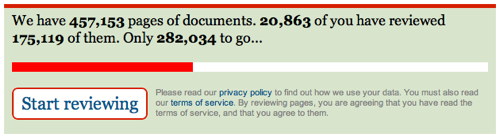
Screen capture of progress bar for the Guardian's "MPs' Expenses" project. Just a slight gaming element aided the productivity of the project greatly. (Image source: Niemanlab.org)
Perhaps my favorite crowdsource success is the (London) Guardian's "MPs' Expenses" project. In 2009, the Guardian acquired nearly half a million documents of British Members of Parliament (MPs) expenses. This was a priceless acquisition for the newspaper, with the potential to expose millions of dollars of misused tax dollars. But one big problem remained--how could they go through it all and find the juicy stuff? The only answer was crowdsourcing. They set up a simple interface online to let anyone come in and read a document and flag anything suspicious for the reporters to look at. To inspire more participation, they added a very light gaming element: progress bars that told users how many pages they had collectively scanned and how many were left, and leader boards showing the most productive users. They also programmed a the site to show a picture of the MP they were researching to come up with each document, making users' efforts seem more personal and real. With this slight competitive drive added to a relevant, pressing cause, users blew through the entire set of documents within a few weeks users. The result was the discovery of over $150 million dollars in unnecessary spending, leading to several disciplinary actions and even some resignations, and an average of 5% decrease in spending across all parties the next year.


World Without Oil

Screenshot of the Week 18 status report from World Without Oil
(Image Source: worldwithoutoil.org)
World Without Oil was a very simple game that existed more in concept than actual code. Quite simply, the game invited people to simulate the first 32 weeks of a global oil crisis through blogs, forums, and wikis, and other online interactions. People from all over the world explored how their lives would change and how they would get by, with everyone offering creative solutions that other people could use. One Brazilian man, for instance, suggested that all those quarter-operated bubble-gum machines could be converted to be seed distribution centers so people could easily access seeds to star their own garden after produce stopped showing up in stores. The game concluded on June 1, 2007 and collected 1,500 personal chronicles posted across the web, reaching 68,000 viewers--and over 110,000 by the end of the year. Due to all the effort put in by the players, thousands of people adopted real-world solutions they had learned by playing, and many viewers and players alike made real lifestyle changes to reduce their oil consumption.

MalariaSpot

A game of MalariaSpot--simple but powerful
(Image Source: MalariaSpot.org)
So far, the only reliable way to diagnose malaria is by looking at blood smears under a microscope and counting the number of parasites. This is time consuming, which is especially frustrating for doctors and experts who have so much else they can do to help people and don't want to spend all their time counting dots in a microscope. MalariaSpot.org is a game meant to solve the problem by letting non-experts look at uploaded microscope photos and spot the parasites themselves. In one study, combining the efforts of just 13 players trained for just one minute each could yield results of over 99% accuracy. Even if the players had no prior training, combining results from 22 players would yield the same results. Rounds of MalariaSpot only last one minute each, so it's extremely low-cost to the players and extremely beneficial to the doctors. So far, over 380,000 parasites have been properly identified by players of MalariaSpot.

And more...

The best part is that crowdsourcing games (and other games built to cause good in the real world) are a growing trend, with real-world results increasing every day. For more information, look around the Games for Change website, an organization dedicated to collecting, promoting, and creating games that make a real-world difference.

Crowdsourcing is an extremely effective tool to solve big problems and achieve big dreams with wide participation done quickly and cheaply. Adding a gaming element to this crowdsourcing inspires even more participation, and rewards participants with fun and satisfaction. Crowdsource gaming (and gaming elements within more traditional crowdsourcing platforms) will only continue to rise as we learn how better to leverage the wisdom of the crowd and better provide satisfactory gameplay experiences around serious issues.

So, what are you still doing here? Go play some games and save the world!