In the non-narrative chapters of Moby Dick, Melville's essentially pulling in the reader further into the world of whaling, building connections that will increase the power of the plot in the reader's heart and mind. By relating everyday objects to large philosophical questions and symbols, Melville builds a collage of meaning over the final scenes of man versus whale in the novel. Through Melville's connective efforts, by the end of the novel we're not just watching a one-legged man chase a white whale, we're watching Satan tempt Jesus, and the world turn more secular, and Peter deny Christ, and America be forged, and several other metaphorical and allegorical applications Melville has built into the story--and infinitely more that he did not build in, but which we can build over the structure he has laid before us.
I want to study in my paper how meaning is established in Moby Dick, and in what ways these techniques can be used to create meaning in the new digital form of video games. I also want to explore how video games can't follow Moby Dick's example, and what video games can do to create meaning that a book could not.
We're very good at finding meaning in books, and pretty good at finding it in movies, because these forms have been around awhile and we have learned how to "read" them for meaning. We don't know how to "read" video games for meaning. Many would argue that this is because video games simply don't have meaning, but I don't believe that for a second. Every English major can attest to having defended a novel as meaningful when someone told them it really "didn't mean anything." I believe this is the same situation. It is true that games have only recently had the economic stability to consider more traditionally artistic themes and tropes--but at the same time, early games might be even more meaningful because they were made despite all the economic difficulty, meaning the creators really had something they wanted to accomplish with it enough to make it happen despite the difficulty.
So, here's a go at a working thesis statement:
Moby Dick is an excellent case study in how novels can create meaning through connecting with readers personally and with larger human themes and ideas. Using this case study, I argue that video games can create meaning in many of the same ways as novels (and in many ways unique to the medium). The only reason we do not find as much meaning in video games as we do in novels is because we have not learned how to find and understanding the meanings games could produce.
Please comment below if you have any questions or insights you think I should consider. Also, if you are on reddit, you can join a similar discussion I started over there.
Thanks!

Showing posts with label connecting. Show all posts
Showing posts with label connecting. Show all posts
Monday, October 7, 2013

Midterm #1 Prewriting: Charting a Path to Connectedness
Here are some quotes and initial thoughts for my investigation of connectedness and isolation through the lens of Melville's Moby Dick:
- "It is a book which could only have been written in America" (vii-viii)
- "Melville wants the whole world in--particularly the human world; hence the slightly improbable spectrum of the crew of the Peqoid" (ix). --> ship as a microcosm of America
- Sea as the new frontier
- "Ishmael, the whale-writer, knows that the great Sperm-Whale, 'scientific' or poetic, lives not complete in any literature . . . his is an unwritten life'. [sic] . . . We must not expect to find Moby Dick in Moby Dick" (xiii). --> In some sense, maybe digital culture is not intended to show us humanity but is rather meant to lead us back to an appreciation of that which is real and present within our lives.
- "Given the radically orphaned condition of modern man (Ishmael ends as an 'orphan', [sic] which is the last word of his book), a danger that Melville could see was the accelerating drift into disconnectedness of the non-affiliated contemporary individual" (xv).
- "How, therefore, men might move from isolation to connectedness was a matter of great moment to him and it pervades the book" (xv).
Sunday, October 6, 2013
Shifting from Physical to Online - Midterm 1
Here are the blog posts I have written so far this semester.
- Things to Know about Aleesha
- Thoughts about How Moby Dick Fits into Digital Culture
- E-books or Printed Books
- Modern Gam = Skype
- QR Codes for Headstones
- Accepting New Technology as Tradition
- Does a Company's Presence Online (or Lack thereof) Affect their Credibility?
- Long Tails, and Machines, and Algorithms, Oh My!
- Peer Reviews through Digital Media
The themes I seem to be the most interested in are the themes that center on how we are shifting traditions from physical to online. Although there are pros and cons to this, the benefits seem to outweigh the problems. A universal culture has developed, but it's all digital. People seem to like it for a myriad of reasons. It's easy and more convenient to access this information. And other times, it's about the kind of information people can access or the types of audiences they can reach.
People can collaborate with one another to make something completely new and different, just like Eric Whitacre's virtual choir. People can get information on any subject they can think of and they don't have to physically go anywhere to get it. People can be self-taught on any subject. People can send messages and connect with friends or family instantly, no matter their locations. The list can go on and on. The point is, we would not be able to do this (at least, not very easily) without the help of the digital culture that is available through the Internet.
We have adapted to this new culture. Kylee, Ariel, and Greg both mentioned that technology has become an extension of ourselves, which can be good and bad, like Derrick discusses in his post. In a way, we are now the product of transmedia; we are adapted and changed for another medium.
The questions I wish to ask are as follows: Are all of these changes necessary? And why do we tend to change when we represent ourselves online?
Friday, September 27, 2013
Does a Company's Presence Online (or Lack thereof) Affect their Credibility?
Jobs that are related to technology and the humanities have
been on the rise. That’s not really news. But sometimes it surprises me just
how important things like social media and programming skills have become to
companies. Just today, I went to the LDS Publications meeting where they
were recruiting interns, and two of those internships are heavily involved with
digital media.
Here is a screen shot of the job description. (Sorry if it's a little small. There needs to be an option between large and extra-large sizes for photos on Blogger.)

There’s also a job board called mediabistro online that has
an entire section dedicated to posting tech jobs that are related in some way
to the media. Again, see the screenshot.
Thursday, September 26, 2013
Fast-Fish and Loose-Fish 2: Digital Fish Edition
On Monday, I talked about Chapter 89 of Moby Dick and the concept of Fast-fish and Loose-fish and how it ultimately serves as a foundation for the creation of meaning within the novel. Today, I want to extend on ideas I started there by applying the concept of Fast-fish and Loose-fish to a wider view of our entire digital age.
To review, I basically argued that all meaning in life--both in art and outside of it--is the product of connection. (Indeed, the more I think about it, I can't really tell a difference between connection and meaning, and it seems the two are almost interchangeable.) If this is all true, then, ultimately, this idea is another key to how the digital age changes everything. New technologies give us different powers of connection, and thus the powers to alter the meaning of nearly everything in our lives.
Digital communication changes the meaning of our lives because it changes the connections in our lives. That sounds big and daunting and somewhat terrible, but it's true in both superficial and profound ways, and isn't necessarily a bad thing. For one, the internet has given rise to millions of meaningful and valuable relationships that wouldn't have ever been possible before. Perhaps where this is most easily seen is the rise of fandoms, or more specifically what I'll just call "Comic Con culture." As Kylee pointed out in her post on the subject, Comic Con is a physical gathering of enormous numbers of fans of several similar but quite distinct fictional universes. Ironically, such conventions have grown as internet technology has become more ubiquitous and powerful. You'd think with more possible digital connection, you wouldn't need to physically gather in one place, but I would argue that Comic Con culture is on the rise because these people spend so much time reading/discussing/watching/playing online with each other that they create real relationships around these fictions, and those relationships climax in a confidence and understanding that can only come with community, leading to more and more people identifying with the community enough to physically attend a convention.
To review, I basically argued that all meaning in life--both in art and outside of it--is the product of connection. (Indeed, the more I think about it, I can't really tell a difference between connection and meaning, and it seems the two are almost interchangeable.) If this is all true, then, ultimately, this idea is another key to how the digital age changes everything. New technologies give us different powers of connection, and thus the powers to alter the meaning of nearly everything in our lives.
 |
| As digital media gives fans more chances to connect with fictional universes, it makes these universes more meaningful for them. |
Monday, September 23, 2013
God in the Whale
A classmate of mine, Shelly, wrote "I believe that Moby Dick does in fact represent God and Ahab's search for him is not for religion or mercy, but to avenge his misfortune - the bad things that have happened to him, such as losing his leg." This is an astute observation, I think, and warrants further investigation. As I've been reading through what at first seemed to be unrelated passages about the physiology and anatomy of whales, I've been thinking about how it all ties into a broader, more general idea, and I've come to the same conclusion as Shelly: that the whale is, in many ways, meant to represent God.
 |
| By EIMJ from deviantART |
This point becomes clearer, I think, with each chapter. In Ch. 68, he is described as "the mystic-marked whale" (276) covered in "undecipherable" hieroglyphs (lit. holy writings), and in Ch. 71, Gabriel, the crazed 'prophet' declares the White Whale to be "the Shaker God incarnated" (284). In Ch. 80, Ishmael comments that sperm whales cause one to "feel the Deity and the dread powers more forcibly than in beholding any other object in living nature, and Ch. 82 paints the whale as an alternate incarnation of the Hindu god Vishnu. These are just a few of the many references that place the whale within a context of deity.
Fast-fish and Loose-Fish
Chapter 89 of Moby Dick ends with these words:
Nothing better summarizes Melville's game (and, ultimately, our whole digital culture, but that will be my other post this week) than these words. Dr. Wickman's lecture on the non-narrative chapters today focused a lot on how Melville took boring subjects in these "extra" chapters and linked them to universal ideas. As I listened, I became more and more certain that in any aspect of humanity, meaning comes from connection. Whether it be personal relationships, literature, work, or anything else, the meaning--in both the sense of definition and of significance--comes from the connection established.
This is the key to Moby Dick, and the principle upon which Melville based his whole art.
"What is the great globe itself but a Loose-Fish? And what are you, reader, but a Loose-Fish and a Fast-Fish, too?"
Nothing better summarizes Melville's game (and, ultimately, our whole digital culture, but that will be my other post this week) than these words. Dr. Wickman's lecture on the non-narrative chapters today focused a lot on how Melville took boring subjects in these "extra" chapters and linked them to universal ideas. As I listened, I became more and more certain that in any aspect of humanity, meaning comes from connection. Whether it be personal relationships, literature, work, or anything else, the meaning--in both the sense of definition and of significance--comes from the connection established.
This is the key to Moby Dick, and the principle upon which Melville based his whole art.
Thursday, September 19, 2013
QR Codes for Headstones
When we talked about the members of the Church and
crowdsourcing, I thought about something I read a few months ago regarding family history work. There
is a new thing that is being placed on headstones—QR codes. This way, if
someone is looking at a headstone and wants to know more about who that person
was, he or she can scan the QR code with their smartphone and lookup the
information on that person. See this article for more information.
 |
| Courtesy of benchilada from flickr.com |
This code that is placed on these headstones can aid family
history work. By scanning the code, the users can have a link to the deceased
person’s information, such as date of birth, date of death, and family trees.
This could mean big things for family history work. I have a
grandpa who is really into family history work, and he would love it if something
like this were on every headstone. When he is doing research on our family, he
will go to the cemeteries, and take pictures of the headstone, and take them to
the library to see if he can find any more information about who that person
was. With this system, he won’t need to go to the library any more to look up
that information; he can look up who that person was right there on the spot,
saving lots of time.
Would we be able to put one of these on every headstone in the
world, though? Not likely. But it’s interesting to think about. These are
becoming more common now, and may become a standard part of the headstone.
Tuesday, September 17, 2013
Modern Gam = Skype
I found the idea of the gam interesting in Moby Dick. For those who don’t remember,
here is a refresher from the novel. “Gam—noun—A social meeting of two (or more)
whale-ships, generally on a cruising-ground; when after exchanging hails, they
exchange visits by boats’ crews: the two captains remaining, for the time, on
board of one ship, and the two chief mates on the other” (216). During this
exchange, the captains and the rest of the crew tell each other the whaling
news, but they would “have an agreeable chat” (214). They were able to do this
as long as they shared a common language. “For not only would they meet with
all the sympathies of sailors, but likewise with all the peculiar
congenialities arising from a common pursuit and mutually shared privations and
perils.”
I got thinking that this is like chatting or Skyping today
in digital culture. There are two (or more) people that come from different
paths of life. One person may be starting a new journey; one may just be finishing
a journey. Yet there is common ground that is found between these people at one
point and this is where they catch up on the goings on of each others’ lives.
This is what we use Skype or chat for—the only difference is the common ground
is virtual, not physical.
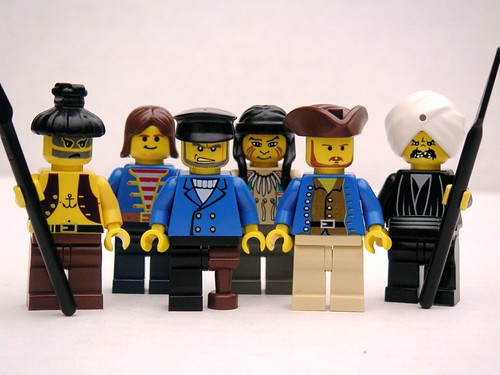 |
| Pardon the inaccuracies, but this was too good not to share. |
We like to share what’s happening in our lives; it’s been
around for a while. It’s just been changing mediums of communication. It’s
quite amazing that we can connect to anyone we want in the world as long as
they have an internet or data connection—or in other words, a common
“technical” language—and speak to them, face-to-face, at least artificially.
Subscribe to:
Posts (Atom)