 In our Digital Culture class, we've already discussed a lot about the complicated idea of what type of book Moby Dick really is. Looking at the digital mediation post Dr. Burton wrote brought me back to that question as he encouraged us to deliberately disrupt the text to see it in a new light. After reading Ian Bogost's How to Do Things with Videogames and pondering game design a lot lately, I started to mediate Moby Dick through the lens of game design, and I wish to argue here how Moby Dick is a game--not that it could be adapted into a game well, but that the book itself is a kind of game.
Showing posts with label digital media. Show all posts
Showing posts with label digital media. Show all posts
Tuesday, November 12, 2013
Moby Dick is a Game
In our Digital Culture class, we've already discussed a lot about the complicated idea of what type of book Moby Dick really is. Looking at the digital mediation post Dr. Burton wrote brought me back to that question as he encouraged us to deliberately disrupt the text to see it in a new light. After reading Ian Bogost's How to Do Things with Videogames and pondering game design a lot lately, I started to mediate Moby Dick through the lens of game design, and I wish to argue here how Moby Dick is a game--not that it could be adapted into a game well, but that the book itself is a kind of game.
Saturday, November 9, 2013
Some of My Favorite Poems On Video
Dr. Burton's post we read for class on video poems inspired me to make a quick collection of a few of my favorite video poems. Here they are!
Taylor Mali is an English teacher and an amazing slam poet. This particular poem is just awesome. There's also a kinetic typography version of the same poem here.
This one caused a lot of buzz on the internet recently, and is interesting both as a poem and a study of the problems (and performance) of OCD.
This one is interesting to me because it's a poem reacting to cartoons turned back into a cartoon.
I love Billy Collins, and this animated version of his poem "The Country" is especially good.
I've actually also made a Facebook group for discussing poetry in contemporary society. You can check it out (and even join if you want!) here.
Taylor Mali is an English teacher and an amazing slam poet. This particular poem is just awesome. There's also a kinetic typography version of the same poem here.
This one caused a lot of buzz on the internet recently, and is interesting both as a poem and a study of the problems (and performance) of OCD.
This one is interesting to me because it's a poem reacting to cartoons turned back into a cartoon.
I love Billy Collins, and this animated version of his poem "The Country" is especially good.
I've actually also made a Facebook group for discussing poetry in contemporary society. You can check it out (and even join if you want!) here.
Monday, October 21, 2013
Storify: The Future of "Primary Documents"
History has always depended on "primary documents"--the words and artifacts of the people who were actually there when important things happened. History in the digital age is no different. We want to get at the source of everything, find the hub of activity online. Thanks to hypertext, it's no easier than ever to jump through the rabbit hole of references back to the "primary document" of anything on the internet--the original YouTube video, the original Tweet, the original Facebook post. Storify is a service that plays to this ability and helps you curate digital primary documents into a "story."
 |
| Screenshot of the landing page for Storify |
Sunday, October 20, 2013
Presenting at RMMLA: My Experience
On October 10, I had the opportunity to present my paper, "'Such Stuff as Dreams are Made On': Shakespeare and the Cultural Legitimacy of Video Games" at the Rocky Mountain Modern Language Association conference. The conference this year was in Vancouver, Washington (no, not Canada and no, not DC). It is unusual for an undergraduate to present at this conference and I was very grateful for the opportunity.
I was very pleasantly surprised by how well my paper was received. Even before the conference started, the panel chair, a professor from Utah State, told me to not be nervous because they were a nice group of people. It also helped that everywhere we went there seemed to be another BYU graduate wanting to talk to us--in the airport, in the hotel, in the room I presented in--everywhere. I was really worried that they'd hear I was an undergraduate and someone would say something about how I wasn't supposed to be there or ask how I ever got in to the conference. I was also worried that I'd get to the conference room and the other presenters would speak and it would all go way over my head and my paper would seem completely juvenile in comparison. Actually, neither of those things happened. I found the other papers super interesting and exciting, and when the time came for Q&A after the presentations, I actually got the bulk of the questions (this might have been in part because I was the last presenter, but it still felt good) and I held my own and had answers for everyone. (Surprisingly, I didn't get the chance to use any of the ten or so answers I had come up with for the questions, "But how can games be art when they're so violent?" because no one asked any version of that question.)
After I finished my presentation, the panel chair asked if I was going to publish my paper and asked the room if they thought I should. They were all very supportive in saying I should publish it somewhere. A woman from The University of Baltimore asked me to email it to her to give to their new Department of Simulation and Digital Entertainment. She said they would love to read it.
Overall, it was an amazing experience and much less intimidating than I thought it would be. The paper was received very well and I'm more excited than ever about my prospects studying video games as an art form.
The full text of my paper can be read and downloaded here.
The accompanying PowerPoint can be viewed and downloaded here.
And, finally, here's a video my lovely wife took of my presentation:
I was very pleasantly surprised by how well my paper was received. Even before the conference started, the panel chair, a professor from Utah State, told me to not be nervous because they were a nice group of people. It also helped that everywhere we went there seemed to be another BYU graduate wanting to talk to us--in the airport, in the hotel, in the room I presented in--everywhere. I was really worried that they'd hear I was an undergraduate and someone would say something about how I wasn't supposed to be there or ask how I ever got in to the conference. I was also worried that I'd get to the conference room and the other presenters would speak and it would all go way over my head and my paper would seem completely juvenile in comparison. Actually, neither of those things happened. I found the other papers super interesting and exciting, and when the time came for Q&A after the presentations, I actually got the bulk of the questions (this might have been in part because I was the last presenter, but it still felt good) and I held my own and had answers for everyone. (Surprisingly, I didn't get the chance to use any of the ten or so answers I had come up with for the questions, "But how can games be art when they're so violent?" because no one asked any version of that question.)
After I finished my presentation, the panel chair asked if I was going to publish my paper and asked the room if they thought I should. They were all very supportive in saying I should publish it somewhere. A woman from The University of Baltimore asked me to email it to her to give to their new Department of Simulation and Digital Entertainment. She said they would love to read it.
Overall, it was an amazing experience and much less intimidating than I thought it would be. The paper was received very well and I'm more excited than ever about my prospects studying video games as an art form.
The full text of my paper can be read and downloaded here.
The accompanying PowerPoint can be viewed and downloaded here.
And, finally, here's a video my lovely wife took of my presentation:
Monday, October 14, 2013
Other Curation Sites
After talking about the idea of curation last week in Digital Cutlure, I thought of a few other examples of curation on the internet that deserve a look.
Tumblr
Tumblr is interesting because there's a pattern that's emerged of someone creating a blog around very specialized topic (for instance, Les Mean Girls, memes mashing Mean Girls quotes with Les Miserables shots). Sometimes, these sites explode, and the creator suddenly becomes a curator as people submit their own ideas to them and they vet and post these submissions to rapidly expand the sites archive. A good example of this is Sims Gone Wrong, a tumblr that's just a big collection of glitches from the popular game The Sims 3. At least in one case, this process has resulted in a creator/curator getting a job. The creator of Onion-like, a tumblr that collects real-world headlines that sound like they came from the popular news satire service The Onion. He was recently given a job at BuzzFeed in major part because of the success of his tumblr.
BuzzFeed
BuzzFeed is an example of curation as a business model. According to their own about section, BuzzFeed is "the leading media company for social news and entertainment, intensely focused on delivering high-quality original reporting, insight, and viral content across a rapidly expanding array of subject areas." What this translates into is a few scattered original articles, and a lot of what is now called "listicles," meaning articles in the form of lists that are light on text and heavy on images (as examples: "42 People You Won't Believe Actually Exist" and "28 Unsettling Animal Mashups That Should Probably Never Have Happened". Most of BuzzFeed's most viral posts fall into this category, meaning most of BuzzFeed's business is just curating internet content (that they often just pull from social media sites like tumblr, deviantart, or reddit).
Songza
The last one I want to talk about is Songza. Songza is a different kind of curation business. The premise of the service is to "play the right music at the right time." When you first open the app/website, it'll display the day of the week and time of day, and offer you moods or situations that might be happening to you right now. When you pick one, it will then present you with a list of playlists that fit that mood/situation. The playlists are curated by music professionals to fit that particular theme. So, like BuzzFeed, Songza is a business model based on curation of internet content, but for a different intent.
The explosion of digital content has made curation more important than ever, and it's quite interesting how it's being implemented to bring people digital content they'll be satisfied by. It's important to note that all of these sites are free--so the only money anyone's making off this is through advertising, putting the pressure on these business to be consistently satisfying to digital consumers so people keep coming back to produce ad revenue for the company. It's an interesting and exciting combination of social and economic forces.
Tumblr
Tumblr is interesting because there's a pattern that's emerged of someone creating a blog around very specialized topic (for instance, Les Mean Girls, memes mashing Mean Girls quotes with Les Miserables shots). Sometimes, these sites explode, and the creator suddenly becomes a curator as people submit their own ideas to them and they vet and post these submissions to rapidly expand the sites archive. A good example of this is Sims Gone Wrong, a tumblr that's just a big collection of glitches from the popular game The Sims 3. At least in one case, this process has resulted in a creator/curator getting a job. The creator of Onion-like, a tumblr that collects real-world headlines that sound like they came from the popular news satire service The Onion. He was recently given a job at BuzzFeed in major part because of the success of his tumblr.
BuzzFeed
BuzzFeed is an example of curation as a business model. According to their own about section, BuzzFeed is "the leading media company for social news and entertainment, intensely focused on delivering high-quality original reporting, insight, and viral content across a rapidly expanding array of subject areas." What this translates into is a few scattered original articles, and a lot of what is now called "listicles," meaning articles in the form of lists that are light on text and heavy on images (as examples: "42 People You Won't Believe Actually Exist" and "28 Unsettling Animal Mashups That Should Probably Never Have Happened". Most of BuzzFeed's most viral posts fall into this category, meaning most of BuzzFeed's business is just curating internet content (that they often just pull from social media sites like tumblr, deviantart, or reddit).
Songza
 |
| Screenshot from Songza.com |
The last one I want to talk about is Songza. Songza is a different kind of curation business. The premise of the service is to "play the right music at the right time." When you first open the app/website, it'll display the day of the week and time of day, and offer you moods or situations that might be happening to you right now. When you pick one, it will then present you with a list of playlists that fit that mood/situation. The playlists are curated by music professionals to fit that particular theme. So, like BuzzFeed, Songza is a business model based on curation of internet content, but for a different intent.
The explosion of digital content has made curation more important than ever, and it's quite interesting how it's being implemented to bring people digital content they'll be satisfied by. It's important to note that all of these sites are free--so the only money anyone's making off this is through advertising, putting the pressure on these business to be consistently satisfying to digital consumers so people keep coming back to produce ad revenue for the company. It's an interesting and exciting combination of social and economic forces.
Midterm 1: Results
For my midterm paper, I did a mix of what I wrote in my midterm posts (here and here), what I'd written in earlier posts (mainly this one, this one), and new stuff that came up as I worked through these ideas. The final result can be seen here (on Skydrive--feel free to comment on it over there--I've never used Skydrive like this before! It could be fun!).
Then, of course, it all just got more complicated when I went to see Dr. Burton and Dr. Wickman. Dr. Wickman pointed out that many of the claims I made are based on assumptions about the theoretical underpinnings of media and "new" media that are actually hot debates currently in the academic world. For example, I say in my paper, "When new mediums arrive, however, no culture exists to prepare their audience to unpack the meaning the creator intended." Dr. Wickman pointed out that this isn't necessarily true, and pointed me to some scholars and books that complicate this idea and argue that even in "new" or "emerging" media, there may be an existing culture impacting it.
After that, the conversation turned to another topic that the shifts in digital culture and digital media makes more complicated and difficult: graduate school. They asked me what what my plans were after graduation, and we discussed the pros and cons of going a more traditionally scholarly route and becoming a professor working with the kinds of ideas I've been developing about video games over the past year or so, or jumping straight into the video game industry and returning to academics later (Dr. Burton pointed out that for this industry, it might be like the business school--you have to work in the field a while to really be an authority on it).
I've already been looking at the University of Utah's top-rated game design program, but since talking to Dr. Burton and Dr. Wickman, I did more research and found out that MIT actually has a Comparative Media Studies/Writing (why the slash? I don't know.) master's degree, which seems like a Digital Culture class on steroids. But programs like that are extremely limited, and majorly untried. What jobs do they lead to? None specifically, but of course the program is extremely relevant to the world today and would lead to all kinds of opportunities. The question of grad school and which school or program to go to is just yet another aspect of life made more complicated by the new digital media and culture.
Then, of course, it all just got more complicated when I went to see Dr. Burton and Dr. Wickman. Dr. Wickman pointed out that many of the claims I made are based on assumptions about the theoretical underpinnings of media and "new" media that are actually hot debates currently in the academic world. For example, I say in my paper, "When new mediums arrive, however, no culture exists to prepare their audience to unpack the meaning the creator intended." Dr. Wickman pointed out that this isn't necessarily true, and pointed me to some scholars and books that complicate this idea and argue that even in "new" or "emerging" media, there may be an existing culture impacting it.
After that, the conversation turned to another topic that the shifts in digital culture and digital media makes more complicated and difficult: graduate school. They asked me what what my plans were after graduation, and we discussed the pros and cons of going a more traditionally scholarly route and becoming a professor working with the kinds of ideas I've been developing about video games over the past year or so, or jumping straight into the video game industry and returning to academics later (Dr. Burton pointed out that for this industry, it might be like the business school--you have to work in the field a while to really be an authority on it).
I've already been looking at the University of Utah's top-rated game design program, but since talking to Dr. Burton and Dr. Wickman, I did more research and found out that MIT actually has a Comparative Media Studies/Writing (why the slash? I don't know.) master's degree, which seems like a Digital Culture class on steroids. But programs like that are extremely limited, and majorly untried. What jobs do they lead to? None specifically, but of course the program is extremely relevant to the world today and would lead to all kinds of opportunities. The question of grad school and which school or program to go to is just yet another aspect of life made more complicated by the new digital media and culture.
Monday, October 7, 2013
Midterm 1: I'll Do This
In the non-narrative chapters of Moby Dick, Melville's essentially pulling in the reader further into the world of whaling, building connections that will increase the power of the plot in the reader's heart and mind. By relating everyday objects to large philosophical questions and symbols, Melville builds a collage of meaning over the final scenes of man versus whale in the novel. Through Melville's connective efforts, by the end of the novel we're not just watching a one-legged man chase a white whale, we're watching Satan tempt Jesus, and the world turn more secular, and Peter deny Christ, and America be forged, and several other metaphorical and allegorical applications Melville has built into the story--and infinitely more that he did not build in, but which we can build over the structure he has laid before us.
I want to study in my paper how meaning is established in Moby Dick, and in what ways these techniques can be used to create meaning in the new digital form of video games. I also want to explore how video games can't follow Moby Dick's example, and what video games can do to create meaning that a book could not.
We're very good at finding meaning in books, and pretty good at finding it in movies, because these forms have been around awhile and we have learned how to "read" them for meaning. We don't know how to "read" video games for meaning. Many would argue that this is because video games simply don't have meaning, but I don't believe that for a second. Every English major can attest to having defended a novel as meaningful when someone told them it really "didn't mean anything." I believe this is the same situation. It is true that games have only recently had the economic stability to consider more traditionally artistic themes and tropes--but at the same time, early games might be even more meaningful because they were made despite all the economic difficulty, meaning the creators really had something they wanted to accomplish with it enough to make it happen despite the difficulty.
So, here's a go at a working thesis statement:
Moby Dick is an excellent case study in how novels can create meaning through connecting with readers personally and with larger human themes and ideas. Using this case study, I argue that video games can create meaning in many of the same ways as novels (and in many ways unique to the medium). The only reason we do not find as much meaning in video games as we do in novels is because we have not learned how to find and understanding the meanings games could produce.
Please comment below if you have any questions or insights you think I should consider. Also, if you are on reddit, you can join a similar discussion I started over there.
Thanks!
I want to study in my paper how meaning is established in Moby Dick, and in what ways these techniques can be used to create meaning in the new digital form of video games. I also want to explore how video games can't follow Moby Dick's example, and what video games can do to create meaning that a book could not.
We're very good at finding meaning in books, and pretty good at finding it in movies, because these forms have been around awhile and we have learned how to "read" them for meaning. We don't know how to "read" video games for meaning. Many would argue that this is because video games simply don't have meaning, but I don't believe that for a second. Every English major can attest to having defended a novel as meaningful when someone told them it really "didn't mean anything." I believe this is the same situation. It is true that games have only recently had the economic stability to consider more traditionally artistic themes and tropes--but at the same time, early games might be even more meaningful because they were made despite all the economic difficulty, meaning the creators really had something they wanted to accomplish with it enough to make it happen despite the difficulty.
So, here's a go at a working thesis statement:
Moby Dick is an excellent case study in how novels can create meaning through connecting with readers personally and with larger human themes and ideas. Using this case study, I argue that video games can create meaning in many of the same ways as novels (and in many ways unique to the medium). The only reason we do not find as much meaning in video games as we do in novels is because we have not learned how to find and understanding the meanings games could produce.
Please comment below if you have any questions or insights you think I should consider. Also, if you are on reddit, you can join a similar discussion I started over there.
Thanks!
Midterm 1: I Did This
So far, I've made the following posts in our Digital Culture class:
- I'm Paul Bills
- I See Why English Professors Love This
- The Democratization of Information Case Study: Reddit
- Give Us Ahab: An Open Letter to Ubisoft
- Crowdsourcing Games: The Fun Way to Change the World
- Fast-Fish and Loose-Fish
- Fast-Fish and Loose-Fish 2: Digital Fish Edition
- Moby Addicted: Is it All Ahab's Fault?
- Spinning Into Control
- The Internet: The End of "The End"?
One theme I see running through all my posts and that I've found some interest in is how digital culture changes the way we make meaning in our lives, and how digital meaning can best create meaning, specifically video games. We talked a lot in class about the "extra" chapters in Moby Dick, and how they add to the meaning of the overall work. Greg talked about how Moby Dick builds both the whale and Ahab into symbols of God and Satan, respectively, exploring another aspect of how meaning is created. I'm interested in the ways digital media--and especially a variety of digital media together--can create new kinds of meaning and more intense, emotionally connected meaning. This idea gets especially interesting as digital media is often in flux--not entirely finished and often iterated and revised, as Dr. Burton talks about in his post on the spiral. Digital media, then, is an interesting blend of authorial intent and influence and a larger relationship between the author(s) and their initial audience, thus blurring that traditional binary as well. Thus, the future of digital media criticism and studies will have to draw not only on traditional literary criticism, but sociology and organizational behavior theories to truly understand the meaning created by a single digital experience. This makes digital media potentially much more powerful, but at the same time much more difficult to manage and control, such that it makes authorial touches fade in the background or lose their footing in the mass of iteration and outside input. Thus, my research question is how can authorial control be exercised over the new digital media--and even across several media simultaneously--to harness the potential of digital media forms to create more powerful meaning both inside the work and outside the work in the reader and world at large?
Midterm #1 Prewriting: Charting a Path to Connectedness
Here are some quotes and initial thoughts for my investigation of connectedness and isolation through the lens of Melville's Moby Dick:
- "It is a book which could only have been written in America" (vii-viii)
- "Melville wants the whole world in--particularly the human world; hence the slightly improbable spectrum of the crew of the Peqoid" (ix). --> ship as a microcosm of America
- Sea as the new frontier
- "Ishmael, the whale-writer, knows that the great Sperm-Whale, 'scientific' or poetic, lives not complete in any literature . . . his is an unwritten life'. [sic] . . . We must not expect to find Moby Dick in Moby Dick" (xiii). --> In some sense, maybe digital culture is not intended to show us humanity but is rather meant to lead us back to an appreciation of that which is real and present within our lives.
- "Given the radically orphaned condition of modern man (Ishmael ends as an 'orphan', [sic] which is the last word of his book), a danger that Melville could see was the accelerating drift into disconnectedness of the non-affiliated contemporary individual" (xv).
- "How, therefore, men might move from isolation to connectedness was a matter of great moment to him and it pervades the book" (xv).
Thursday, October 3, 2013
Peer Reviews through Digital Media
After this was mentioned in class, I wanted to find out a little
bit more about how content that is not peer-reviewed can still be considered a
reliable source of information.
I came across this article, which talks about the new system of
peer-reviewing when content is published instantly.
“In the case of social platforms, the metric that drives discovery is how much interaction there is with your content on the social platform in question. Examples of such interaction include the numbers of followers you have and the number of times your content is shared, liked, commented on, [and] viewed.These metrics show how much interest there is in your papers, and how widely they are read right now, and thus provide a sense of their level of impact.”
 |
| Courtesy of birgerking from flickr.com |
Personally, I’m not sure I’m ready to accept this as a
reliable peer review. While something may be popular and getting lots of likes
and shares on Facebook (we’ve all see, or even shared, those Huffington Post
articles), that doesn’t mean it is ready to be cited in an academic paper. While it’s great that ideas and content can
be published instantly, they still need to take the next step to phase three of
academic blogging to be taken seriously.
So, what are your thoughts? Can something be considered a
reliable source if it is getting a lot of attention online?
The Internet: The End of "The End"?
 |
| Paul Valéry (image source goodreads.com) |
Dr. Burton pointed out in the lecture this week that perhaps one of the biggest dividing lines between print and digital culture is that print is by necessity finished product gone through several reviewers and editors before it's put out into wide distribution, while the internet is instant wide distribution of whatever people want.
At the same time, Dr. Burton encouraged us to put out ideas through blogging that we might not otherwise put out for the world to see to allow others to help us in the creative process so we can make something better than we'd make on our own. This is certainly the process the digital age has taken on in many ways. News stories on the internet often end in something like "We will continue to update this story as details come out." These stories are then edited several times over days or weeks before they're left alone not because they're finished as much because there are other stories to write at that point. In video games, it is becoming increasingly popular to open up development to beta and even alpha testing as the developers continue to work on the game before it's official "release." Steam, the most popular online game store and platform for PC games, now has a section of the store dedicated to these "early access" games. Even after games are released, they are often updated through downloaded patches, which, again, only really end when people stop playing the game, not when the game's "finished."
Wednesday, October 2, 2013
My Research, Your Voice
 |
| By Giulia Forsythe |
Monday, September 30, 2013
Don Yer Blubber, Land Lubber!
Today, I want to talk about blubber. In class, we discussed the idea of varying degrees of symbolic and/or narrative usefulness within certain sections of Melville's Moby Dick. One particular topic that came up over the course of the discussion was blubber, and I think we were maybe too quick in asserting that there is nothing to be learned from whale fat.
In Ch. 68, Melville, discussing blubber, writes:
 |
| Creative Commons License, by Jenny Spadafora |
In Ch. 68, Melville, discussing blubber, writes:
[H]erein we see the rare virtue of a strong individual vitality, and the rare virtue of thick walls, and the rare virtue of interior spaciousness. Oh, man! admire and model thyself after the whale! Do thou, too, remain warm among ice. Do thou, too, live in this world without being of it.This principle of maintaining a so-called "interior spaciousness"--a personal identity or "room of one's own"--proves particularly important within the context of the modern age. A study presented by Katie Davis in "Young People’s Digital Lives: The Impact of Interpersonal Relationships and Digital Media Use on Adolescents’ Sense of Identity" suggest that identity exploration and use of social media have both direct and indirect negative effects on adolescents' "self-concept clarity." The distillation of that is that as they use digital media exploratively, adolescents (and I would guess this could be extended at least marginally to adults as well) lose a sense of personal identity or rather lose clarity in their understanding of the concept of self.
Monday, September 23, 2013
Accepting New Technology as Tradition
After today’s lecture from Dr. Wickman, I got thinking about
how traditions are often reasons why some people are not as willing to be as
explorative as others.
In chapter 69 on page 278, it describes what happens to the
whale after its carcass is let go in the ocean: "When the distance obscuring
the swarming fowls, never the less still shows the whit mass floating in the
sun, and the white spray heaving high against it; straightway the whale’s
unharming corpse, with trembling fingers is set down in the log—shoals, rocks,
and breakers hereabouts: beware! And for years afterwards, perhaps, ships shun
the place; leaping over it as silly sheep leap over a vacuum, because their
leader originally leaped there when a stick was held. There’s your law of
precedents; there’s your utility of traditions; there’s the story of your
obstinate survival of old beliefs never bottomed on the earth, and now not ever
hovering in the air! There’s orthodoxy."
As Dr. Wickman pointed out in class, this relates to
religion. But I would like to postulate that this idea of blind following that
is being suggested is not only pertinent to religion but to technology as well.
People don’t like there to be a lot of changes in their
lives. Throwing changes into a normal and structured life, at least for people
like me, can give a “you-threw-off-my-groove” kind of vibe, and it takes time
to accept the change. We are creatures of habit.
 |
| Courtesy of Mike Licht, NotionsCapital.com, flickr.com |
Thursday, September 19, 2013
Crowdsourcing Games: The Fun Way to Change the World
Dr. Burton talked to us in class yesterday about crowdsourcing and creativity and how the digital age provides us ways to create things together like never before. Today, I'm going to talk about a few crowdsourcing projects that have been packaged as a game to inspire more effort, creativity, and time out of participants.
Foldit
We talked about one such game in class, called Foldit. Foldit is a game about protein folding that invites players to find patterns in complex proteins and play around with them and try and fold them into the best possible shape so it has the function biologists want it to have. Proteins can fold into almost an infinite amount of shapes, with each shape causing the protein to function differently. Because of this, predicting what shape the protein needs to be in to function properly (to cure a disease, for example) is very difficult and very expensive, even with advanced supercomputers. The game, then, finds a way to leverage the creative and pattern-recognition powers of the human brain, and makes it fun to solve an extremely complex problem. Foldit has already helped with research on HIV, cancer, and Alzheimer's disease.
Perhaps the most surprising and wonderful result of Foldit is that even Ph.D. biologists aren't necessarily the best players. Players come from all backgrounds and many of the best players are neither biologists nor tech experts. It's true crowdsourcing--a project that becomes more than the sum of its parts.
But Foldit isn't the only crowdsourcing game out there. Several others have been very successful in solving all kinds of world problems, from oil to malaria, government spending and more.
The Guardian's "MPs' Expenses" Project
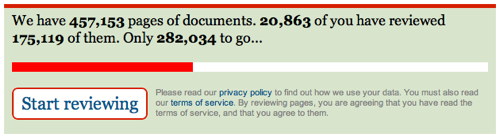
Perhaps my favorite crowdsource success is the (London) Guardian's "MPs' Expenses" project. In 2009, the Guardian acquired nearly half a million documents of British Members of Parliament (MPs) expenses. This was a priceless acquisition for the newspaper, with the potential to expose millions of dollars of misused tax dollars. But one big problem remained--how could they go through it all and find the juicy stuff? The only answer was crowdsourcing. They set up a simple interface online to let anyone come in and read a document and flag anything suspicious for the reporters to look at. To inspire more participation, they added a very light gaming element: progress bars that told users how many pages they had collectively scanned and how many were left, and leader boards showing the most productive users. They also programmed a the site to show a picture of the MP they were researching to come up with each document, making users' efforts seem more personal and real. With this slight competitive drive added to a relevant, pressing cause, users blew through the entire set of documents within a few weeks users. The result was the discovery of over $150 million dollars in unnecessary spending, leading to several disciplinary actions and even some resignations, and an average of 5% decrease in spending across all parties the next year.
World Without Oil
World Without Oil was a very simple game that existed more in concept than actual code. Quite simply, the game invited people to simulate the first 32 weeks of a global oil crisis through blogs, forums, and wikis, and other online interactions. People from all over the world explored how their lives would change and how they would get by, with everyone offering creative solutions that other people could use. One Brazilian man, for instance, suggested that all those quarter-operated bubble-gum machines could be converted to be seed distribution centers so people could easily access seeds to star their own garden after produce stopped showing up in stores. The game concluded on June 1, 2007 and collected 1,500 personal chronicles posted across the web, reaching 68,000 viewers--and over 110,000 by the end of the year. Due to all the effort put in by the players, thousands of people adopted real-world solutions they had learned by playing, and many viewers and players alike made real lifestyle changes to reduce their oil consumption.
MalariaSpot
So far, the only reliable way to diagnose malaria is by looking at blood smears under a microscope and counting the number of parasites. This is time consuming, which is especially frustrating for doctors and experts who have so much else they can do to help people and don't want to spend all their time counting dots in a microscope. MalariaSpot.org is a game meant to solve the problem by letting non-experts look at uploaded microscope photos and spot the parasites themselves. In one study, combining the efforts of just 13 players trained for just one minute each could yield results of over 99% accuracy. Even if the players had no prior training, combining results from 22 players would yield the same results. Rounds of MalariaSpot only last one minute each, so it's extremely low-cost to the players and extremely beneficial to the doctors. So far, over 380,000 parasites have been properly identified by players of MalariaSpot.
And more...
The best part is that crowdsourcing games (and other games built to cause good in the real world) are a growing trend, with real-world results increasing every day. For more information, look around the Games for Change website, an organization dedicated to collecting, promoting, and creating games that make a real-world difference.
Crowdsourcing is an extremely effective tool to solve big problems and achieve big dreams with wide participation done quickly and cheaply. Adding a gaming element to this crowdsourcing inspires even more participation, and rewards participants with fun and satisfaction. Crowdsource gaming (and gaming elements within more traditional crowdsourcing platforms) will only continue to rise as we learn how better to leverage the wisdom of the crowd and better provide satisfactory gameplay experiences around serious issues.
So, what are you still doing here? Go play some games and save the world!
Foldit
 |
| Folder Madde's top scoring solution to the Mason pfizer monkey virus (image credit: Fold.it) |
Perhaps the most surprising and wonderful result of Foldit is that even Ph.D. biologists aren't necessarily the best players. Players come from all backgrounds and many of the best players are neither biologists nor tech experts. It's true crowdsourcing--a project that becomes more than the sum of its parts.
But Foldit isn't the only crowdsourcing game out there. Several others have been very successful in solving all kinds of world problems, from oil to malaria, government spending and more.
The Guardian's "MPs' Expenses" Project
 |
| Screen capture of progress bar for the Guardian's "MPs' Expenses" project. Just a slight gaming element aided the productivity of the project greatly. (Image source: Niemanlab.org) |
World Without Oil
 |
| Screenshot of the Week 18 status report from World Without Oil (Image Source: worldwithoutoil.org) |
MalariaSpot
 |
| A game of MalariaSpot--simple but powerful (Image Source: MalariaSpot.org) |
And more...
The best part is that crowdsourcing games (and other games built to cause good in the real world) are a growing trend, with real-world results increasing every day. For more information, look around the Games for Change website, an organization dedicated to collecting, promoting, and creating games that make a real-world difference.
Crowdsourcing is an extremely effective tool to solve big problems and achieve big dreams with wide participation done quickly and cheaply. Adding a gaming element to this crowdsourcing inspires even more participation, and rewards participants with fun and satisfaction. Crowdsource gaming (and gaming elements within more traditional crowdsourcing platforms) will only continue to rise as we learn how better to leverage the wisdom of the crowd and better provide satisfactory gameplay experiences around serious issues.
So, what are you still doing here? Go play some games and save the world!
Tuesday, September 17, 2013
Modern Gam = Skype
I found the idea of the gam interesting in Moby Dick. For those who don’t remember,
here is a refresher from the novel. “Gam—noun—A social meeting of two (or more)
whale-ships, generally on a cruising-ground; when after exchanging hails, they
exchange visits by boats’ crews: the two captains remaining, for the time, on
board of one ship, and the two chief mates on the other” (216). During this
exchange, the captains and the rest of the crew tell each other the whaling
news, but they would “have an agreeable chat” (214). They were able to do this
as long as they shared a common language. “For not only would they meet with
all the sympathies of sailors, but likewise with all the peculiar
congenialities arising from a common pursuit and mutually shared privations and
perils.”
I got thinking that this is like chatting or Skyping today
in digital culture. There are two (or more) people that come from different
paths of life. One person may be starting a new journey; one may just be finishing
a journey. Yet there is common ground that is found between these people at one
point and this is where they catch up on the goings on of each others’ lives.
This is what we use Skype or chat for—the only difference is the common ground
is virtual, not physical.
 |
| Pardon the inaccuracies, but this was too good not to share. |
We like to share what’s happening in our lives; it’s been
around for a while. It’s just been changing mediums of communication. It’s
quite amazing that we can connect to anyone we want in the world as long as
they have an internet or data connection—or in other words, a common
“technical” language—and speak to them, face-to-face, at least artificially.
Saturday, September 14, 2013
Avatars and Anonymity: Who are We?
In my digital culture class, we talked a few days ago about the idea of online avatars, and that got me thinking about my personal online presence--who I am, where I've been, and how I seek to portray myself. As you may know, avatars (not to be confused with an excellent series on Nickelodeon that enjoyed the premier of its second season this last Friday) are basically personae that we use to represent ourselves on the internet: usernames, profile pictures, blog layouts, "likes" and +1's--they all reflect who we are, or at least whom we wish to be seen as.

When I was sixteen or so, I got my start into the digital world through a web community based around a popular computer game called Warcraft III. This handsome fellow on the right was me from 2006-2009 (I bet you didn't know I was a night elf, right?) Now, you can hold your laughs and everything, because honestly, this community was one of the best things that happened to me in high school, it being the primary motivator for my creative and academic pursuits at the time. It was on this web community that I developed my first real interest in 2D and 3D art; here I made my first forays into programming, learning a C++ derivative and creating my own game and a number of AI engines; here I discussed philosophy, religion, politics, and ethics in ways that I had never done with anyone except for my best friend, Jordan. It truly was a haven for me, a place where I could escape to interact in meaningful ways with creators and thinkers from around the globe. And really, those people were some pretty close friends. I remember getting back from my mission and feeling a little bit like Marius form Les Mis when I went back to check on old friends--realizing that these people with whom I had once been so close had dissolved into the ether of the Internet.

When I was sixteen or so, I got my start into the digital world through a web community based around a popular computer game called Warcraft III. This handsome fellow on the right was me from 2006-2009 (I bet you didn't know I was a night elf, right?) Now, you can hold your laughs and everything, because honestly, this community was one of the best things that happened to me in high school, it being the primary motivator for my creative and academic pursuits at the time. It was on this web community that I developed my first real interest in 2D and 3D art; here I made my first forays into programming, learning a C++ derivative and creating my own game and a number of AI engines; here I discussed philosophy, religion, politics, and ethics in ways that I had never done with anyone except for my best friend, Jordan. It truly was a haven for me, a place where I could escape to interact in meaningful ways with creators and thinkers from around the globe. And really, those people were some pretty close friends. I remember getting back from my mission and feeling a little bit like Marius form Les Mis when I went back to check on old friends--realizing that these people with whom I had once been so close had dissolved into the ether of the Internet.
Thursday, September 12, 2013
E-books or Printed Books?
The future of publishing is in e-books, at least that’s what
I keep reading. However, my professors in editing and publishing hesitate to
make that same claim. And, after doing a bit of research, I can see why. Yes,
publishing electronic content has become very huge; people can download this
content onto their smartphones or tablets and take it with them anywhere.

Most of the users who read e-books will still buy physical
copies of books as well. I, too, am one of those people. I have a Kindle Fire,
and I love that I can purchase books without needing to go to a bookstore,
which is great because the nearest Barnes and Noble is thirty minutes away from
my house. That being said, I don’t buy a lot of books on my Kindle. I get the
public domain books because they are free, and I will occasionally buy a
bargain book when the price is right. However, when it comes to a book that I
know I will want to read again or lend to friends or family members, I will buy
the printed book. I know some people that will only buy the physical copies of
books. And, despite the convenience of e-books, they will never consider letting
go of their physical books or trying a device such as an e-reader.
This article from the Wallstreet
Journal reported at the beginning of the year that brought up a good point:
e-books are just another format. They serve a different purpose from the
physical copies of books. So, just because there is a large, growing market for
e-books, that doesn’t necessarily mean that the market for printed books will
shrink and disappear for good.
Wednesday, September 11, 2013
Digital Text, Plato, and Dynamic Expression: A Vlog
Some of my classmates have posted some great info on XML code and the potentialities of digital text on our respective group blogs. Here's a post that explains the basics of XML, and you can access all the blogs through http://mobydigital.blogspot.com. Okay, now watch the video :)
Here's the link to Wesch's video! https://www.youtube.com/watch?feature=player_embedded&v=NLlGopyXT_g#t=192
And here's Dr. Burton's original blog post: http://mobydigital.blogspot.com/2013/09/michael-weschs-machine-is-using-us.html
[Transcript below]
Monday, September 9, 2013
The Sea and Solitude
In the introductory notes to the Oxford World Classics edition of Moby Dick, we read of the idea of a "lost origin," (xiv) of "paternity unknown" and the quest for belonging, for the archetypical or symbolic "mythic womb." While these ideas are a bit abstract and perhaps unapproachable for the common man, Melville did, in fact, see mankind in a state of insularity or isolation--a state wherein individuals, though surrounded by other people, were endlessly and needlessly alone. For Melville, learning to overcome this isolation was one of the primary aims of life and literature (see Introduction, xv).
 The beginning of Moby Dick is full of disconnected, discontented strangers. Really, the only real references to union or companionship include:
- the couples huddled in the Whalemen's Chapel
- Captains Peleg and Bildad
- Queequog and Ishmael.
Subscribe to:
Posts (Atom)