Showing posts with label connectivity. Show all posts

Thursday, October 3, 2013

"Another and still stranger world..."

Ch. 11, Moby Dick, by Herman Melville
Recently, I wrote a blog post, a Google+ message, and a Facebook plea asking for you to help me choose between research topics, and the tally is in. I'm proud to announce that I'll be researching 'digital worlds unseen'--that is, the digital universes that oft times go completely unnoticed in the 'real' world despite their apparent complexity and outright intrigue.

In light of our study of Moby Dick, this is an especially pertinent topic, for in some sense, the leviathans of Melville's work live in a world that is to us likewise unknown and unseen--a place that's neither understood nor appreciated by the vast majority of people. We perhaps catch a tiny glimpse of that world every now and then in our brief encounters with its strange inhabitants, but we otherwise remain blissfully (and sometimes sanctimoniously) ignorant to these worlds lurking just beneath the threshold of our perception. Well, I want to change that.

Thursday, September 26, 2013

Fast-Fish and Loose-Fish 2: Digital Fish Edition

On Monday, I talked about Chapter 89 of Moby Dick and the concept of Fast-fish and Loose-fish and how it ultimately serves as a foundation for the creation of meaning within the novel. Today, I want to extend on ideas I started there by applying the concept of Fast-fish and Loose-fish to a wider view of our entire digital age.

To review, I basically argued that all meaning in life--both in art and outside of it--is the product of connection. (Indeed, the more I think about it, I can't really tell a difference between connection and meaning, and it seems the two are almost interchangeable.) If this is all true, then, ultimately, this idea is another key to how the digital age changes everything. New technologies give us different powers of connection, and thus the powers to alter the meaning of nearly everything in our lives.

As digital media gives fans more chances to connect with fictional universes,
it makes these universes more meaningful for them.
Digital communication changes the meaning of our lives because it changes the connections in our lives. That sounds big and daunting and somewhat terrible, but it's true in both superficial and profound ways, and isn't necessarily a bad thing. For one, the internet has given rise to millions of meaningful and valuable relationships that wouldn't have ever been possible before. Perhaps where this is most easily seen is the rise of fandoms, or more specifically what I'll just call "Comic Con culture." As Kylee pointed out in her post on the subject, Comic Con is a physical gathering of enormous numbers of fans of several similar but quite distinct fictional universes. Ironically, such conventions have grown as internet technology has become more ubiquitous and powerful. You'd think with more possible digital connection, you wouldn't need to physically gather in one place, but I would argue that Comic Con culture is on the rise because these people spend so much time reading/discussing/watching/playing online with each other that they create real relationships around these fictions, and those relationships climax in a confidence and understanding that can only come with community, leading to more and more people identifying with the community enough to physically attend a convention.

Monday, September 23, 2013

Fast-fish and Loose-Fish

Chapter 89 of Moby Dick ends with these words:

"What is the great globe itself but a Loose-Fish? And what are you, reader, but a Loose-Fish and a Fast-Fish, too?"

Nothing better summarizes Melville's game (and, ultimately, our whole digital culture, but that will be my other post this week) than these words. Dr. Wickman's lecture on the non-narrative chapters today focused  a lot on how Melville took boring subjects in these "extra" chapters and linked them to universal ideas. As I listened, I became more and more certain that in any aspect of humanity, meaning comes from connection. Whether it be personal relationships, literature, work, or anything else, the meaning--in both the sense of definition and of significance--comes from the connection established.

This is the key to Moby Dick, and the principle upon which Melville based his whole art.

Thursday, September 12, 2013

The Democratization of Information Case Study: Reddit

reddit alien mascot thing (Image credit: AJC1)
We've been talking about the effects the new digital media have had/are having on our culture a lot in this first week of class, and so for my first digital culture post I'd like to kill two birds with one stone (or harpoon two whales with one spear, as it were). First, I'm going to talk about how the idea of democracy has influenced the development of the internet, and at the same time, I'm going to teach you all about reddit, an undervalued and awesome tool to discover, research, and read amazing content on the internet.

Are you ready? Here we go!

Possibly one of the greatest cultural shifts in human history happened in ancient Greece when the Athenians became the first group of human beings to govern themselves by communal vote rather than being ruled by a single monarch or family. While this system of government didn't last very long, relatively speaking, it inspired thinkers over a millennium later in the 18th century during the Enlightenment period. Thanks to their help and other social and political changes, democracy regained strength, climaxing in the creation of the United States of America.

As you know, the USA became the greatest power on Earth over the course of the next two and a half centuries. And everywhere America's long and powerful arm stretched, democracy went with it. Because America was founded on such passionate (and even violent) terms around the idea of democracy, it became the most deep-rooted value of our culture, with almost everything built up to promote and maintain it.So naturally, when new forms of communication developed in a world where America sat in both the political and cultural spotlight, democracy was built in their DNA.
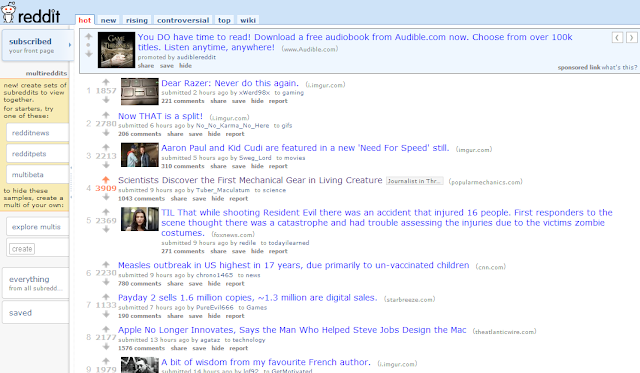
A screenshot of a reddit front page. Stories are put on the front page based on how many upvotes they have received, how quickly, and how recently.
You can see democracy all over the internet--in the nearly ubiquitous comments sections, in the rise of crowd-funding sites like Kickstarter, and in free sharing sites like YouTube--but perhaps one of the places where democracy is most directly implemented on the internet is reddit (not a typo, they specifically ask to have it stylized with no caps). On reddit, users can post links or text for others to view. Other users can then "upvote" or "downvote" them so they get more or less visibility on the site. reddit is internally divided into "subreddits," communities based around a single topic. There are subreddits for just about everything imaginable, from gifs to physics to flight simulators to onions. Users can subscribe to any combination and number of subreddits to provide personalized content much like a feed reader or news aggregator.

The end result of all of this is a dynamic collection of content that changes rapidly throughout the day and is constantly up to the very second with the newest information. Because of that, reddit has become a source for many major news sites, and often has information long before any other site as people on-site when big stories happen can post images and information and other users can send it to the top of the site (also called the "front page") so that it gets out to everyone faster. Also, anyone who creates quality content on the internet can post it for review on reddit (within a fit subreddit), and quickly receive wide exposure as individual users upvote the content and it gets spread to more users interested in the topic the subreddit is based around. Therefore, reddit becomes empowering in two ways: it lets otherwise powerless people get their voice heard, and it lets the people decide what is the best and most important content to be viewed.

So, reddit helps make the internet more democratic, and we can see the internet is fundamentally influenced by democratic ideals. This observation begs the question, then: what would the internet be like if America and democracy hadn't risen in prominence in the world in recent history? Would we even have the internet at all? It's weird to think wars fought 200 years ago determine how you find funny cat videos today, but these are exactly the kinds of connections the digital humanities are here to find.


Monday, September 9, 2013

The Sea and Solitude

In the introductory notes to the Oxford World Classics edition of Moby Dick, we read of the idea of a "lost origin," (xiv) of "paternity unknown" and the quest for belonging, for the archetypical or symbolic "mythic womb." While these ideas are a bit abstract and perhaps unapproachable for the common man, Melville did, in fact, see mankind in a state of insularity or isolation--a state wherein individuals, though surrounded by other people, were endlessly and needlessly alone. For Melville, learning to overcome this isolation was one of the primary aims of life and literature (see Introduction, xv).

The beginning of Moby Dick is full of disconnected, discontented strangers. Really, the only real references to union or companionship include:

  •  the couples huddled in the Whalemen's Chapel 
  • Captains Peleg and Bildad
  • Queequog and Ishmael.